
A Level Math vs AP Calculus: Which Is Better for College?
Choosing an advanced mathematics course can be a big decision, especially if you are planning for college in the U.S. or another international destination. Two options students often compare are A Level Mathematics and AP Calculus.
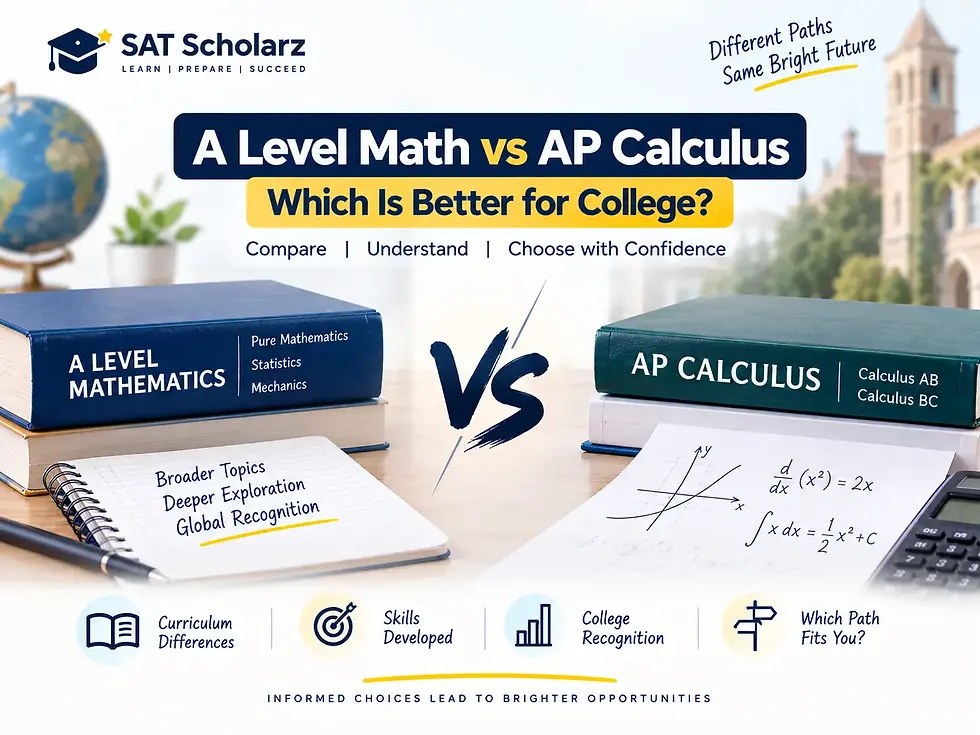
But these programs are not exactly designed to do the same thing. A Level Mathematics generally provides a broader study of advanced mathematics, while AP Calculus focuses specifically on calculus at a college level.
So, when comparing A Level Math vs AP Calculus, which one is better for college?
The answer depends on your academic goals, intended major, target universities, current preparation, and the curriculum available at your school.
What Is A Level Mathematics?
A Level Mathematics is an advanced secondary-school qualification offered through examination boards such as Cambridge International. The curriculum can include pure mathematics along with applied areas such as mechanics and probability and statistics, depending on the route selected.
Students develop skills such as:
Algebra and functions
Calculus
Mathematical reasoning
Trigonometry
Coordinate geometry
Probability and statistics
Mechanics, depending on the syllabus route
Mathematical modelling and problem-solving
The broader structure of A Level Mathematics can make it particularly useful for students who want a strong overall mathematics foundation before university.
For students considering mathematics-intensive degrees, the depth and breadth of the qualification can be valuable preparation for further study.
What Is AP Calculus?
AP Calculus is a College Board Advanced Placement course designed to introduce students to college-level calculus while they are still in high school.
There are two main courses:
AP Calculus AB
AP Calculus BC
AP Calculus AB covers topics such as limits, differentiation, integration, differential equations, and applications of calculus. College Board describes it as equivalent to a first-semester college calculus course.
AP Calculus BC builds on the AB curriculum and includes additional topics such as parametric equations, polar coordinates, vector-valued functions, and infinite sequences and series. College Board describes BC as equivalent to a first-semester college calculus course plus the subsequent single-variable calculus course.
Students who perform well on an AP Calculus exam may also be eligible for college credit or placement, depending on the policies of the university they attend.
A Level Math vs AP Calculus: Key Differences
Although both are rigorous mathematics options, their structure and emphasis are different.
Factor | A Level Mathematics | AP Calculus |
Main focus | Broad advanced mathematics | College-level calculus |
Calculus | Significant part of the curriculum | Central focus |
Other mathematics | Pure mathematics plus possible statistics/mechanics | Primarily calculus |
Structure | Multi-component qualification | Individual AP course and exam |
Assessment | Depends on examination board and syllabus | AP exam |
Best suited for | Students seeking broader mathematical preparation | Students seeking focused calculus preparation |
College credit | Depends on university and qualification | Depends on AP score and university policy |
International use | Widely used internationally | Primarily associated with U.S. high schools but recognized by universities internationally |
The important point is that A Level Mathematics and AP Calculus measure somewhat different types of preparation. One should not automatically be considered better simply because it is more advanced in one particular area.
A Level Mathematics vs AP Calculus: Curriculum
One of the biggest differences between A Level Math vs AP Calculus is the breadth of mathematics covered.
A Level Mathematics can combine pure mathematics with applied mathematics. For example, the Cambridge International 2026–2027 syllabus includes Pure Mathematics components alongside options involving Mechanics and Probability & Statistics.
AP Calculus, on the other hand, is much more focused on calculus.
Students study concepts such as:
Limits and continuity
Differentiation
Applications of differentiation
Integration
Applications of integration
Differential equations
Mathematical modelling
AP Calculus BC goes further by including topics such as parametric equations, polar coordinates, vector-valued functions, and infinite series.
The simple difference
A Level Mathematics = broader advanced mathematics
AP Calculus = more focused calculus preparation
Which Is More Rigorous: A Level Math or AP Calculus?
This is one of the most common questions students ask, but there is no universal winner. The difficulty depends on the specific syllabus, course structure, school, teacher, assessment system, and the student's mathematical background.
A Level Mathematics may feel more demanding because students work across a broader range of mathematical topics.
AP Calculus can be particularly challenging for students because it requires them to understand calculus concepts, apply them in different representations, and communicate mathematical reasoning accurately.
AP Calculus BC also goes beyond AB with additional calculus topics and is designed as a more extensive college-level calculus experience.
Rather than asking “Which is harder?”, it is more useful to ask:
“Which qualification provides the type of mathematical preparation I need?”
A Level Math vs AP Calculus for U.S. College Admissions
If you are applying to colleges in the United States, both A Level Mathematics and AP Calculus can demonstrate advanced academic preparation.
However, admissions decisions are not normally based on a single course or qualification in isolation. Universities may consider:
Your overall academic record
The rigor of your available curriculum
Your grades
Your intended major
Your extracurricular activities
Your essays and recommendations
Your school context
Your overall academic progression
For a student applying to a mathematics-intensive program, advanced mathematics can be particularly relevant.
For example, a student interested in engineering, mathematics, physics, computer science, or economics may want to demonstrate that they have challenged themselves mathematically when appropriate opportunities are available.
This does not mean that AP Calculus automatically carries more weight than A Level Mathematics, or vice versa.
The stronger choice is generally the one that fits your academic pathway and allows you to perform well while taking appropriately challenging coursework.
A Level Math vs AP Calculus for UK Universities
The comparison can look different if your goal is to study in the United Kingdom.
A Level qualifications are deeply integrated into the UK education system, and A Level Mathematics is commonly relevant for degrees that require substantial mathematical preparation.
For some mathematics-intensive courses, universities may specify particular mathematics subjects or grades as part of their entry requirements.
That means students applying to UK universities should check the specific entry requirements for each course and university rather than assuming that AP Calculus and A Level Mathematics are interchangeable.
AP qualifications can still be considered by UK universities, but requirements vary.
Always check the current requirements of your target university and degree program before choosing your final subjects.
Which Is Better for STEM Students?
For students interested in STEM, the right choice depends heavily on the intended field.
Engineering
Both pathways can provide useful mathematical preparation.
A Level Mathematics may provide broader mathematical exposure, while AP Calculus can provide focused preparation in calculus.
Mathematics
Students intending to study mathematics may benefit from a curriculum that gives them strong preparation across multiple mathematical areas.
A Level Mathematics can provide broader coverage, while AP Calculus BC offers substantial calculus preparation.
Physics
Strong calculus and mathematical reasoning are important for many physics pathways.
Students should also consider what additional mathematics and science courses are available at their school.
Computer Science
Calculus can be useful for some areas of computer science, but mathematical preparation requirements vary considerably by university and program.
Students should look beyond the course title and check the prerequisites for their intended degree.
Economics
Calculus and quantitative reasoning can both be useful for economics.
The most appropriate preparation depends on the level of mathematics expected by the universities and programs you are considering.
AP Calculus AB vs AP Calculus BC
If you are already considering the AP pathway, you may also be wondering whether to choose AP Calculus AB or BC.
AP Calculus AB focuses on differential and integral calculus and is described by College Board as equivalent to a first-semester college calculus course.
AP Calculus BC includes the AB material and extends it with additional topics, including parametric equations, polar coordinates, vector-valued functions, and infinite series.
So, if your preparation and school curriculum allow it, BC can provide a more extensive calculus experience.
However, taking BC simply because it sounds more advanced is not necessarily the right decision for every student.
The best course is one where you have the preparation and support needed to succeed.
Can You Take Both A Level Math and AP Calculus?
In some school systems, students may have the opportunity to study both.
However, whether this is worthwhile depends on your academic situation.
Taking both may make sense if:
Your school offers both programs
You have strong mathematics preparation
The courses complement rather than unnecessarily duplicate each other
You have a clear academic reason for taking both
The workload is manageable
Taking additional advanced mathematics solely to make your application look stronger is not always the best strategy.
A balanced academic program with strong performance is generally more useful than taking too many difficult courses and struggling to maintain your overall performance.
A Level Math vs AP Calculus: Which Should You Choose?
There is no single answer for every student.
Choose A Level Mathematics if:
You want broader advanced mathematics preparation
Your school follows an A Level curriculum
You are considering universities where A Levels are a major part of the admissions pathway
You want exposure beyond calculus
Your intended degree benefits from broad mathematical preparation
Consider AP Calculus if:
You are following a U.S.-style high school curriculum
You want focused calculus preparation
Your school offers AP Calculus AB or BC
You are preparing for a STEM-related college pathway
You want the possibility of AP credit or placement where your target university offers it
Consider AP Calculus BC if:
You already have strong preparation in algebra, geometry, trigonometry, and functions
You want a more extensive calculus curriculum
Your school offers BC and you can manage the course successfully
Your intended academic pathway benefits from advanced calculus
A Level Math vs AP Calculus: Frequently Asked Questions
Is A Level Math harder than AP Calculus?
Not necessarily. They have different structures and goals. A Level Mathematics generally covers a broader range of advanced mathematics, while AP Calculus focuses more specifically on calculus.
Is AP Calculus equivalent to A Level Mathematics?
No. They should not be treated as direct equivalents. Their curricula, assessment structures, and areas of emphasis are different.
Is A Level Mathematics accepted by U.S. universities?
A Level qualifications are used internationally and can be considered by U.S. universities. However, admissions and credit policies vary by institution, so students should check the requirements of each university.
Is AP Calculus accepted by UK universities?
AP qualifications can be considered by UK universities, but requirements vary by university and degree. Students should check the specific course entry requirements.
Which is better for engineering: A Level Math or AP Calculus?
Both can provide valuable mathematical preparation. The better option depends on the requirements of your target engineering programs and the other mathematics and science courses available to you.
Should I take AP Calculus AB or BC?
If you have the required mathematical preparation and your school offers BC, it provides broader calculus coverage than AB. However, your ability to succeed in the course should be a major consideration.
Can I take A Level Math and AP Calculus together?
It may be possible in some schools, but it is not automatically necessary. Consider the academic benefit, workload, overlap, and requirements of your target universities before taking both.
Final Thoughts
When comparing A Level Math vs AP Calculus, the goal should not be to find one qualification that is universally “better.”
A Level Mathematics generally offers broader advanced mathematical preparation, while AP Calculus provides a focused college-level calculus pathway.
Your best choice depends on your:
Intended college major
Target universities
Current mathematics preparation
School curriculum
Study destination
Academic goals
If you are unsure which pathway fits your college plans, start by looking at the mathematics requirements of the universities and majors you are considering. Then choose the course that gives you the strongest preparation while remaining realistic for your academic situation.
Need help strengthening your AP Calculus preparation? SAT Scholarz offers personalized AP courses and tutoring designed to help students build subject knowledge, practice effectively, and prepare with greater confidence.

Comments